
Study resources
The full reference that goes with the periodic table on the back of your ClipDesk board. Free, works on your phone, and prints cleanly.
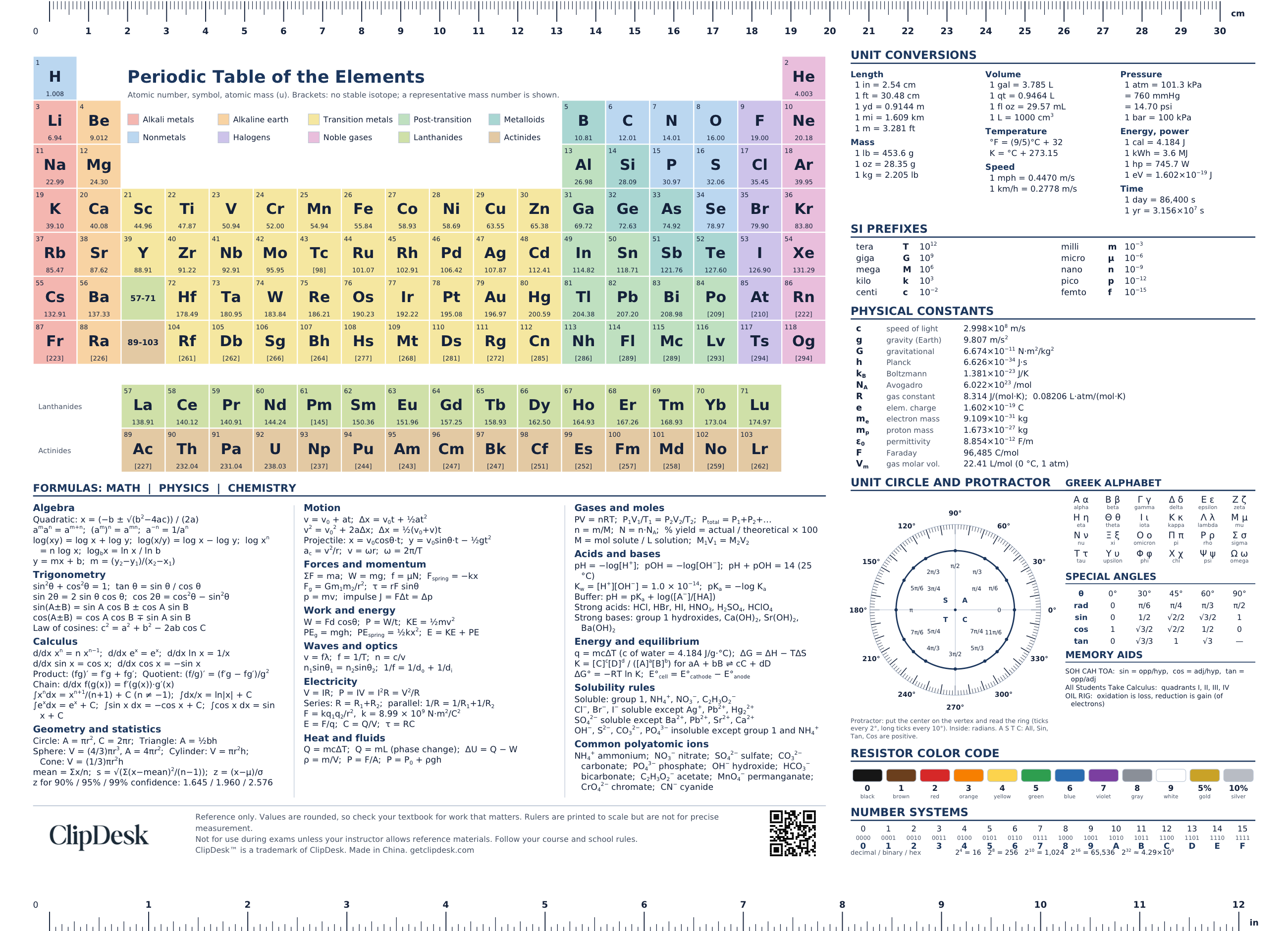
The full reference sheet
The original big board-back reference: periodic table, rulers, formulas, conversions, constants, unit circle, protractor and more. Tap an image to open it full size. Download the PDF to print it at 13 x 9.4 in.
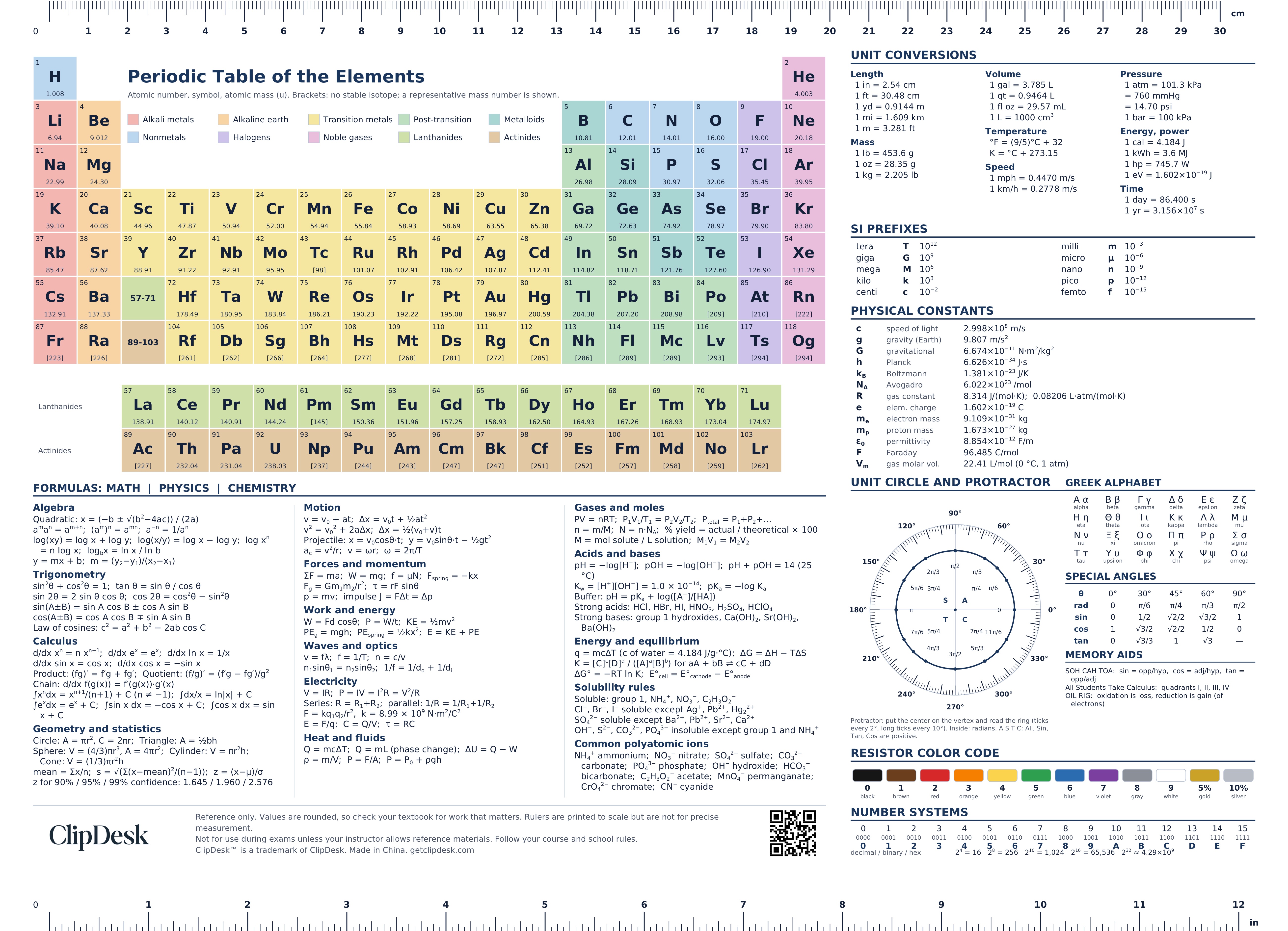
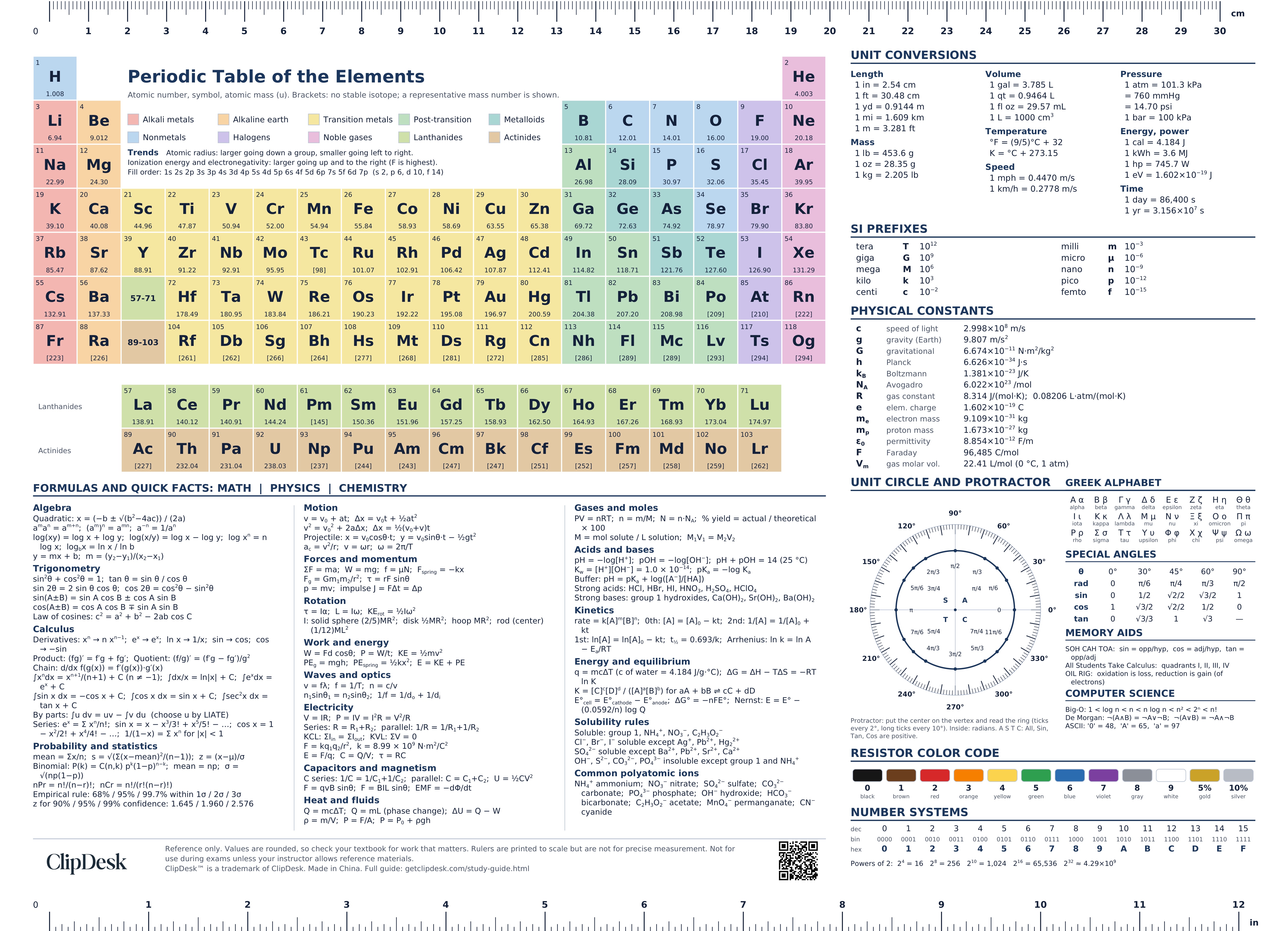
The board itself ships with the simple periodic table back (PDF), so it stays test-friendly.
UCSD course guides
Pick your course to see what it covers and jump straight to the formula cards for it. Course lists come from the UCSD General Catalog. Browse all undergraduate courses or graduate courses. Exams vary by instructor, so check your syllabus.
Math
MATH 2
- linear relationships
- polynomials
- rational and radical equations
- exponentials and logs
- geometry and trig
MATH 3B
- functions
- polynomial and rational
- exponential and log
- trig
MATH 4C
- graphing
- circular functions
- vectors
- conics
- polar coordinates
MATH 10B
- integration
- FTC
- integration methods
- areas and volumes
- separable ODEs
MATH 11
- probability
- random variables
- distributions
- CLT
- inference
- regression
MATH 18
- matrices
- Gaussian elimination
- determinants
- eigenvalues
- diagonalization
MATH 20B
- integration methods
- infinite series
- polar coordinates
- complex exponentials
MATH 20C
- vector functions
- partial derivatives
- extrema
- double integrals
MATH 20D
- first and second order ODEs
- systems
- series solutions
- Laplace transforms
MATH 20E
- Jacobians
- line integrals
- Green's, Stokes', Gauss' theorems
MATH 31BH
- multivariable derivatives
- Jacobians
- extrema
- multiple integrals
MATH 31CH
- change of variables
- differential forms
- generalized Stokes
MATH 102
- Hermitian matrices
- quadratic forms
- norms
- singular values
MATH 104A
- unique factorization
- congruences
- reciprocity
- cryptography
MATH 109
- proofs
- quantifiers
- induction
- sets
- epsilon-delta
MATH 110
- heat, wave, Laplace equations
- separation of variables
- Fourier series
MATH 111A
- epidemic, chemical-reaction and population models
MATH 112A
- population dynamics
- gene regulation
- oscillators
MATH 114
- random numbers
- Monte Carlo
- MCMC
MATH 120A
- analytic functions
- Cauchy theorems
- residues
MATH 120B
- residues
- conformal maps
- Fourier and Laplace transforms
MATH 130
- phase portraits
- limit cycles
- bifurcations
MATH 140A
- real numbers
- topology
- sequences and series
- continuity
MATH 144
- Fourier series and transforms
- convergence
MATH 146
- linear systems
- matrix exponential
- stability
MATH 148
- characteristics
- wave and heat equations
- Green's functions
MATH 154
- trees
- connectivity
- matchings
- coloring
- planar graphs
- flows
MATH 155A
- Bezier curves
- de Casteljau
- barycentric coordinates
MATH 170A
- least squares
- orthogonalization
- eigenvalue computation
MATH 170B
- root finding
- interpolation
- approximation
MATH 170C
- numerical differentiation and integration
- ODE solvers
MATH 171A
- simplex
- duality
- network flows
MATH 171B
- Newton methods
- constrained optimization
- KKT
MATH 173A
- convexity
- LP and QP
- SVMs
MATH 174
- floating point
- solvers
- ODE and BVP methods
MATH 175
- finite difference and finite element methods
MATH 180A
- probability spaces
- random variables
- expectation
- CLT
MATH 180B
- multivariate normal
- random walks
- Poisson process
MATH 180C
- Markov chains
- queues
- branching
MATH 181A
- estimation
- MLE
- confidence intervals
- hypothesis tests
MATH 181D
- dimension reduction
- classification
- boosting
- SVMs
MATH 183
- distributions
- CLT
- intervals
- tests
- curve fitting
MATH 184
- permutations
- partitions
- inclusion-exclusion
- generating functions
MATH 187A
- classical ciphers
- DES
- public-key systems
MATH 189
- R
- sampling
- bootstrap
- regression diagnostics
MATH 194
- martingales
- arbitrage pricing
- options
Physics
PHYS 1A
- Newtonian motion
- forces
- gravity
- energy
- momentum
- rotation
- fluids
PHYS 1B
- electric and magnetic fields
- DC and AC circuits
PHYS 1C
- oscillations
- waves
- sound
- light
- quantum basics
PHYS 2A
- vectors
- kinematics
- Newton's laws
- energy
- momentum
- rotation
- gravitation
PHYS 2B
- electric fields
- Gauss's law
- circuits
- magnetism
- induction
- Maxwell
PHYS 2C
- fluids
- waves
- heat
- entropy
- EM waves
- optics
PHYS 2D
- relativity
- Bohr model
- wave-particle duality
- Schrodinger equation
- radioactivity
PHYS 4A
- kinematics
- dynamics
- conservation laws
- rotation
- oscillations
- central forces
PHYS 4B
- damped oscillations
- fluids
- waves
- thermodynamics
- kinetic theory
PHYS 4C
- Coulomb
- fields
- Gauss's law
- capacitors
- circuits
- Faraday
PHYS 4D
- Maxwell
- EM waves
- special relativity
- interference
- diffraction
PHYS 4E
- Schrodinger equation
- spin
- identical particles
- quantum statistics
PHYS 41
- Python
- data analysis
- visualization
- numerical methods
- simulation
PHYS 100A
- electrostatics
- conductors and dielectrics
- steady currents
PHYS 100C
- EM waves
- radiation
- charged particles in fields
PHYS 105A
- Fourier methods
- special functions
- BVPs
- Green's functions
- PDEs
PHYS 110A
- phase flows
- oscillations
- Lagrangian dynamics
- central forces
PHYS 110B
- noninertial frames
- rigid bodies
- Hamiltonian dynamics
- chaos
PHYS 116
- Navier-Stokes
- instabilities
- boundary layers
- turbulence
- shocks
PHYS 120
- analog design
- amplifiers
- filters
- sensors
- digitization
PHYS 130B
- matrix mechanics
- angular momentum
- spin
- approximation methods
PHYS 140A
- thermodynamics
- partition function
- free energy
- quantum gases
PHYS 140B
- third law
- kinetic theory
- transport
- critical phenomena
PHYS 152A
- crystal structure
- diffraction
- phonons
- band theory
- semiconductors
PHYS 154
- quarks
- leptons
- interactions
- symmetries
- electroweak
PHYS 160
- stellar structure and evolution
- white dwarfs
- neutron stars
PHYS 170
- spectroscopy
- microscopy
- ultrasound
- X-ray
- MRI
- lasers
Chemistry
CHEM 6A
- atomic theory
- bonding
- molecular geometry
- stoichiometry
- reaction types
CHEM 6B
- gases
- liquids
- solids
- thermochemistry
- equilibria
- solubility
CHEM 6C
- kinetics
- acid-base equilibria
- electrochemistry
- coordination
- nuclear
CHEM 7L
- analytical, inorganic, physical and synthetic lab techniques
CHEM 40A
- bonding
- stereochemistry
- spectroscopy
- substitution
CHEM 40B
- carbonyl reactivity
- enzymatic catalysis
- electrophilic reactions
CHEM 40C
- carboxylic acids
- carbohydrates
- proteins
- fatty acids
- natural products
CHEM 41A
- bonding
- isomerism
- stereochemistry
- conformations
CHEM 41B
- alcohols
- ethers
- aromatics
- organometallics
- carbonyls
CHEM 41C
- compound classes
- multi-step synthesis
CHEM 43A
- separation
- purification
- spectroscopy
- product analysis
CHEM 100A
- quantitative analysis
- gravimetric methods
- intro to instrumental analysis
CHEM 100B
- GC
- MS
- HPLC
- ion chromatography
- AAS
- fluorescence
- IR
CHEM 105A
- experimental physical chemistry
CHEM 114A
- nucleic acids
- proteins
- enzymes
- carbohydrates
- lipids
CHEM 114B
- glycolysis
- Krebs cycle
- oxidative phosphorylation
CHEM 114C
- protein and nucleic acid biosynthesis
- cellular control
CHEM 120A
- main-group structure, bonding, reactivity
CHEM 120B
- transition metals
- coordination chemistry
- organometallics
CHEM 126A
- thermodynamics and kinetics of biomolecules
- enzyme kinetics
CHEM 126B
- quantum and statistical mechanics of biomolecules
- spectroscopy
- NMR
CHEM 130
- quantum mechanics
- atomic and molecular spectroscopy
CHEM 131
- thermodynamics
- chemical and phase equilibria
- solutions
CHEM 132
- statistics
- kinetic theory
- reaction kinetics
CHEM 143B
- synthetic organic methods
CHEM 146
- rate laws
- transition state theory
- isotope and solvent effects
CHEM 154
- substitutions
- eliminations
- rearrangements
- radicals
- photochemistry
CHEM 156
- catalytic rate laws
- free-energy relationships
- pKa
CHEM 158
- spectroscopic structure determination
CHEM 167
- receptor-protein interactions
- drug design
- pharmacokinetics
CHEM 171
- air pollution
- ozone depletion
- climate change
- energy
CHEM 173
- photochemistry
- radical reactions
- aerosols
- ozone
CHEM 190
- linear algebra
- group theory
- transforms
- differential equations
Mechanical and Aerospace (MAE)
MAE 02
- aerodynamics
- propulsion
- flight mechanics
- orbital mechanics
MAE 03
- design process
- CAD
- prototyping
- shop skills
MAE 08
- arrays
- plotting
- symbolic math
- equation solving
MAE 11
- energy
- heat
- work
- first and second laws
- power and refrigeration cycles
- combustion
MAE 20
- atomic structure
- defects
- phase diagrams
- mechanical and electrical properties
- diffusion
MAE 21
- structure
- defects
- phase diagrams
- testing
- processing
MAE 30A
- rigid-body statics
- centroids
- particle kinematics and kinetics
- friction
MAE 30B
- energy methods
- Lagrange
- impact
- 3-D rigid body
- 1-DOF vibrations
MAE 40
- RLC circuits
- Kirchhoff
- node and mesh analysis
- op-amps
- motors
MAE 101A
- statics
- kinematics
- conservation laws
- Bernoulli
- potential flow
- similitude
MAE 101B
- laminar and turbulent flow
- pipe friction
- boundary layers
- drag and lift
- compressible flow
- shocks
MAE 101D
- numerical conduction
- boiling
- condensation
- natural convection
- heat exchangers
MAE 104
- subsonic and supersonic flow over wings and bodies
- thin-wing theory
MAE 105
- Fourier series
- Sturm-Liouville
- PDEs
- integral transforms
MAE 107
- linear and nonlinear solvers
- interpolation
- least squares
- ODE numerics
MAE 108
- probability
- random variables
- CLT
- reliability
- estimation
- hypothesis tests
MAE 110
- IC, diesel, gas turbine cycles
- mixtures
- chemical and phase equilibrium
MAE 113
- compressible flow
- combustion
- gas turbines
- rockets
MAE 114
- liquid and solid rockets
- electric propulsion
- launch
MAE 118
- energy sources
- heat engines
- pollution
- climate change
MAE 119
- solar radiation
- PV
- solar thermal
- wind
- Betz's law
MAE 120
- fission
- fusion
- reactors
- waste
MAE 121
- atmospheric stability
- plume dispersion
- air quality models
MAE 125
- building thermodynamics
- envelope heat transfer
- HVAC
- codes
MAE 130
- forced vibration
- multi-DOF
- continuous systems
- Hamilton's equations
MAE 131A
- stress and strain
- Hooke's law
- torsion
- beam bending
- combined loading
- buckling
MAE 131B
- 3-D stress
- elasticity
- stress concentration
- failure criteria
- energy methods
MAE 133
- stiffness and mass matrices
- static and dynamic FE analysis
MAE 142
- vehicle dynamics
- stability
- aircraft modes
- state-space control
MAE 143A
- state-space modeling
- linearization
- Laplace
- transfer functions
- z-transform
- Fourier
MAE 143B
- frequency-domain feedback
- PID
- Routh-Hurwitz
- root locus
- Bode and Nyquist
MAE 144
- unstable robot
- embedded Linux
- continuous and discrete control
MAE 145
- planning
- A*
- configuration space
- SLAM
MAE 146
- supervised learning
- regression
- neural networks
- k-means
MAE 148
- 1/8-scale autonomous cars
- computer vision
- navigation
- sensor fusion
MAE 149
- sensors
- signal processing
- wireless networking
MAE 150
- tolerances
- Monte Carlo
- linkages and cams
- optimization
- FEA
MAE 153
- failure theories
- static and fatigue design
- shafts
- gears
- bearings
- fasteners
MAE 154
- user needs
- concepts
- prototyping
- business plans
MAE 155A
- conceptual, preliminary and detailed vehicle design
MAE 156A
- design process
- component analysis
- team project
MAE 160
- elasticity
- plasticity
- dislocations
- creep
- strengthening
- fracture
- fatigue
- composites
MAE 165
- crack growth
- fracture toughness
- fatigue testing
- fractography
MAE 170
- measurement and control
- error and noise
- filtering
- DAQ
MAE 171A
- fluids, solids and control experiments
- error analysis
- reports
MAE 175A
- wind tunnel
- gyroscope control
- vibration table
MAE 180
- orbital motion
- perturbations
- orbit determination
- maneuvers
- interplanetary
MAE 181
- mission architecture
- orbit design
- subsystems
- cost and risk
MAE 182
- guidance
- tracking
- navigation
- link budgets
MAE 184
- 6-DOF equations of motion
- numerical integration
- linearization
MAE 185
- finite difference and volume solutions of Navier-Stokes
Electrical and Computer Engineering (ECE)
ECE 5
- circuits
- embedded systems
- signals
- DSP
ECE 15
- control and data structures
- pointers
- memory management
ECE 16
- EMG controller
- sampling
- signal processing
- microcontrollers
ECE 17
- OO design
- modern C++
- design patterns
- STL
ECE 18
- Python
- common modules
- OO design
ECE 25
- Boolean algebra
- combinational and sequential logic
ECE 30
- information representation
- computer organization
- assembly
ECE 35
- Kirchhoff
- Thevenin and Norton
- nodal analysis
- transients
- sinusoidal steady state
ECE 45
- steady state
- first and second order systems
- Fourier and Laplace
- filters
ECE 65
- diodes
- BJTs and FETs
- small-signal circuits
ECE 100
- frequency response
- Laplace
- op-amp filters
- stability
ECE 101
- complex variables
- Fourier, Laplace, z-transforms
- sampling
- stability
ECE 102
- nonlinear devices
- linearization
- small-signal circuits
ECE 103
- semiconductor physics
- doping
- p-n junctions
- BJTs
- MOS
ECE 107
- Maxwell
- plane waves
- transmission lines
- Smith chart
- waveguides
ECE 108
- CMOS logic
- noise margins
- delays
- power
- memory
ECE 109
- probability
- random variables
- CLT
- estimation
- hypothesis tests
ECE 111
- FSM synthesis
- hazards
- pipelining
- design automation
ECE 118
- buses
- interrupts
- DMA
- serial and parallel communication
- A/D and D/A
ECE 121A
- generation and distribution
- steady-state analysis
- economic operation
ECE 121B
- electromechanical conversion
- three-phase
- transformers
- machines
ECE 123
- impedance
- patterns
- gain
- polarization
- arrays
- link budgets
ECE 124
- DC and induction motor drives
- vector control
ECE 125A
- power semiconductors
- rectifiers
- DC-DC converters
- thermal design
ECE 125B
- converter design
- PWM rectifiers
- inverters
ECE 135A
- crystal structure
- band structure
- carrier transport
- junctions
ECE 135B
- BJT, JFET and MOS structure and operation
- DC and AC characteristics
ECE 141A
- C++ data structures
- algorithms
- design patterns
ECE 143
- Python
- NumPy
- Pandas
- Matplotlib
ECE 148
- scale autonomous cars
- ROS
- computer vision
- deep learning
ECE 153
- stationary processes
- power spectral density
- Gaussian processes
- noise
ECE 155
- digital modulation
- ISI
- fading
- optimal detection
ECE 157A
- modulation and demodulation
- signal impairments
ECE 158A
- layered architecture
- data link
- multiple access
- flow control
- routing
ECE 159
- entropy
- mutual information
- channel capacity
- codes
ECE 161A
- DTFT
- FFT
- FIR and IIR filter design
ECE 161B
- sampling and quantization
- oversampling
- multirate processing
ECE 163
- feedback
- stability
- active filters
- switched-capacitor
- PLLs
- data conversion
ECE 164
- op-amps
- regulators
- oscillators
- noise
ECE 165
- VLSI
- logic styles
- clocking
- ALUs
- memory
ECE 166
- distributed circuits
- S-parameters
- matching
- amplifiers
ECE 171A
- frequency-domain stability
- root locus
- Bode/Nyquist
- compensators
ECE 171B
- state space
- controllability and observability
- pole placement
ECE 174
- least squares
- constrained optimization
- nonlinear methods
ECE 175A
- statistical classifiers
- regression
- clustering
ECE 176
- neural networks
- training
- PyTorch
ECE 181
- ray and wave optics
- diffraction
- Fourier imaging
ECE 182
- polarization
- waveguide modes
- fiber dispersion
ECE 183
- lasers
- photodetection
- electro-optics
- fiber systems
ECE 187
- radiography
- CT
- MRI
- ultrasound
- microscopy
Computer Science (CSE)
CSE 5
- AI foundations
- ML basics
- ethics
CSE 8A
- variables
- conditionals
- loops
- functions
- lists
- dictionaries
CSE 11
- OOP
- Java
- recursion
- file I/O
CSE 12
- linked lists
- stacks
- queues
- trees
- hash tables
CSE 20
- logic
- sets
- relations
- functions
- proofs
- induction
CSE 21
- counting
- complexity
- recurrences
- graphs
- probability
CSE 29
- C
- program execution
- gdb
- valgrind
- make
- UNIX
CSE 30
- assembly
- digital logic
- processor design
- memory hierarchy
CSE 42
- Arduino team devices
CSE 100
- balanced trees
- graphs
- priority queues
- hash tables
- amortized analysis
CSE 101
- sorting
- searching
- graph algorithms
- NP-completeness
CSE 103
- distributions
- hypothesis testing
- Bayes and MLE
- entropy
CSE 105
- automata
- formal languages
- Turing machines
- undecidability
CSE 106
- shortest paths
- flows
- LP, integer and convex programming
- gradient methods
CSE 107
- block ciphers
- public-key
- protocols
- zero-knowledge
CSE 110
- specification
- design
- testing
- agile
- version control
CSE 120
- processes
- synchronization
- scheduling
- virtual memory
- file systems
CSE 124
- data centers
- TCP
- RPC
- load balancing
- secure communication
CSE 127
- crypto basics
- threat analysis
- access control
- exploits
CSE 130
- language design and comparison
CSE 131
- parsing
- type checking
- code generation
- optimization
CSE 140
- Boolean logic
- combinational and sequential design
- state machines
CSE 141
- processor and control design
- memory systems
CSE 142
- pipelining
- caches
- SIMD
- multicore
- x86
CSE 143
- VLSI
- logic design
- CAD
- layout
CSE 147
- processors
- sensors
- actuators
- real-time scheduling
CSE 150A
- Bayesian networks
- MDPs
- inference
CSE 150B
- A*
- adversarial search
- MCTS
- reinforcement learning
CSE 151A
- kNN
- decision trees
- boosting
- perceptrons
- k-means
CSE 151B
- neural networks
- backprop
- CNNs
- RNNs
- transformers
CSE 152A
- image formation
- filtering
- features
- stereo
CSE 156
- language models
- classification
- sequence models
- parsing
CSE 158
- predictive analytics
- recommendation methods
CSE 160
- parallel architectures
- MPI
- speedup
- Amdahl's law
CSE 167
- transformations
- curves
- surfaces
- shading
- graphics APIs
CSE 168
- ray tracing
- acceleration structures
- sampling
- global illumination
CSE 170
- user-centered design
- prototyping
- evaluation
CSE 180
- bioinformatics with Python
CSE 181
- alignment
- database search
- phylogenetics
Bioengineering (BENG)
BENG 1
- design projects
- prototyping
- testing
- ethics
BENG 2
- MATLAB basics
- plotting
- curve fitting
BENG 100
- probability
- distributions
- CLT
- hypothesis testing
BENG 102
- proteins
- nucleic acids
- metabolites
- cellular design
BENG 103B
- diffusion
- convection
- reaction-diffusion
- active transport
BENG 110
- statics
- dynamics
- kinematics
- tissue material properties
BENG 112A
- stress and strain
- constitutive laws
- viscoelasticity
- finite elasticity
BENG 112B
- hydrostatics
- circulation
- biopolymers
- cell mechanics
BENG 120
- carbon compounds
- stereochemistry
- biomolecules
BENG 123
- reaction networks
- kinetics
- simulation
BENG 125
- ODE, SDE and PDE models
- excitable cells
- time series
BENG 130
- thermodynamics
- molecular reactions
- kinetic models
BENG 133
- number representation
- linear systems
- ODE solvers
BENG 134
- estimation
- hypothesis tests
- regression
BENG 135
- convolution
- Fourier
- sampling
- Laplace
BENG 140A
- cell function
- control systems
- muscle
- neural
- circulatory
BENG 140B
- digestive
- respiratory
- renal systems
- metabolism
BENG 141
- light in tissue
- OCT
- microscopy
- spectroscopy
BENG 152
- instrumentation
- biosignal acquisition
- microcontrollers
BENG 160
- protein and nucleic acid assays
- separations
- purification
BENG 161A
- enzyme kinetics
- mass transfer
- fermentation design and scale-up
BENG 161B
- recombinant production
- bioseparations
- bioprocess economics
BENG 166A
- cell behavior
- microenvironment
- tissue substitutes
BENG 168
- recombinant DNA
- biomolecule design
- diagnostics
BENG 186A
- polymers
- biocompatibility
- devices
- regulation
BENG 186B
- transducers
- biopotentials
- sensors
- electrical safety
BENG 189
- models of muscle, kidney transport and neural circuits
Chemical Engineering and NanoEngineering (CENG, NANO)
CENG 100
- steady and unsteady balances
- degrees of freedom
- reaction kinetics
- phase equilibrium
CENG 101A
- hydrostatics
- Bernoulli
- viscous and pipe flow
- boundary layers
- drag
CENG 101B
- conduction
- convection
- radiation
- exchanger design
CENG 101C
- diffusive and convective mass transfer
- coefficients
CENG 102
- properties of substances and mixtures
- phase and chemical equilibria
- cycles
CENG 113
- rate equations
- batch and continuous reactors
- selectivity
- residence time
CENG 114
- probability
- CLT
- regression
- hypothesis tests
CENG 120
- linearized models
- stability
- PID
- Bode and Nyquist
- root locus
CENG 122
- distillation
- extraction
- absorption
- membranes
CENG 124A
- flow diagrams
- costing
- simulation
- recycle
- safety
CENG 157
- crystal growth
- thin films
- oxidation
- CVD and PVD
- doping
- etching
CENG 160
- biomacromolecules
- enzyme kinetics
- metabolism
- bioreactors
CENG 170
- measurement
- error analysis
- DAQ
- technical writing
NANO 11
- scaling laws
- nanomaterials synthesis and properties
- nanomedicine
NANO 15
- MATLAB for nano, chemical and materials problems
NANO 20L
- chemical synthesis of nanomaterials
- characterization
NANO 100L
- thermal, optical, acoustic and magnetic measurements
NANO 102
- thermodynamics of small systems
- diffusion
- colloids
- catalysis
- surfaces
NANO 103
- biomolecules
- interactions
- signaling
- detection
NANO 104
- quantum mechanics
- Schrodinger
- band theory
- nanoelectronics
NANO 106
- crystal symmetry
- tensors
- X-ray, neutron and electron diffraction
NANO 107
- CMOS
- scaling
- amplifiers
- filters
- digital logic
NANO 108
- atomic structure
- defects
- phase diagrams
- mechanical, electrical, magnetic properties
NANO 110
- molecular mechanics
- MD
- Monte Carlo
NANO 111
- optical and electron microscopy
- scanning probes
- spectroscopy
NANO 114
- probability
- regression
- intervals
- tests
NANO 117
- conduction
- convection
- laminar flow
- diffusion
NANO 141A
- force and moment vectors
- free body diagrams
- friction
NANO 141B
- particle and rigid-body dynamics
- energy
- Lagrange
- vibration
NANO 148
- laws
- statistical thermodynamics
- multiphase equilibria
- electrochemistry
NANO 150
- continuum and atomistic models
- elasticity
- plasticity
- fracture
NANO 158
- diffusion
- transformations
- microstructure
NANO 159
- electrode reactions
- techniques
- energy applications
NANO 161
- requirements
- property-based selection
- optimization
NANO 164
- fuel cells
- batteries
- PV
- thermoelectrics
NANO 168
- semiconductors
- piezo and ferroelectrics
- magnetic materials
NANO 174
- plasticity
- strengthening
- failure modes
NANO 181
- ML
- regression
- dimensionality reduction
- classification
Structural Engineering (SE)
SE 1
- structural behavior
- design process
- failures
- ethics
SE 9
- MATLAB
- functions
- loops
- OOP
- physics models
SE 101C
- damped 1-DOF and MDOF
- normal modes
- Lagrange
- modal superposition
SE 102
- interpolation
- integration
- ODEs
- linear and nonlinear systems
SE 103
- materials
- loads and load paths
- code design
- analysis methods
SE 105
- stress and strain
- strength
- fatigue
- creep
- concrete, wood, steel, aluminum, composites
SE 110A
- stress and strain
- torsion
- bending
- shear
- deflections
- indeterminate problems
SE 110B
- unsymmetric bending
- curved beams
- shear center
- column stability
- elasticity
SE 115
- statics
- conservation
- Bernoulli
- pipe and open-channel flow
SE 125
- probability
- inference
- distributions
- structural reliability
SE 130A
- indeterminate analysis
- matrix methods
- direct stiffness
SE 131A
- Galerkin models
- heat conduction
- stress analysis
- error analysis
SE 132
- supervised and unsupervised learning
- neural networks
- Python
SE 140A
- team design, build and test
- codes
- sustainability
SE 142
- micromechanics
- stiffness
- ply stress
- failure
SE 143A
- aircraft and spacecraft design
- minimum-weight design
SE 150A
- LRFD
- steel properties
- tension, compression, beams, connections
SE 151A
- concrete and reinforcement
- limit state design
- detailing
SE 152
- seismic philosophy
- ductility
- lateral systems
- nonlinear behavior
SE 154
- wood
- beams
- columns
- diaphragms
- shear walls
- connections
SE 160A
- flight loads
- 3D stress and strain
- failure theories
- thin-walled multicell
SE 160B
- energy methods
- FEA
- plate and shell bending
- buckling
- flutter
SE 163
- signal processing
- ultrasonic testing
- impact-echo
- acoustic emission
SE 164
- sensing
- uncertainty
- signal conditioning
- DAQ
SE 165
- DAQ
- feature extraction
- statistical modeling
SE 167
- Fourier transform
- digital filtering
- feature extraction
SE 180
- seismic hazard
- response spectra
- modal and time-history analysis
- codes
SE 181
- soil properties
- compaction
- effective stress
- seepage
- consolidation
- shear strength
SE 182
- soil exploration
- shallow and deep foundations
- settlement
- bearing capacity
SE 184
- mechanical, hydraulic, chemical and inclusion methods
Precalculus and calculus (I, II, III)
Precalculus: functions and algebra
Trig identities (complete)
Calculus I: limits and continuity
Calculus I: derivative rules (complete)
Calculus I: applications of derivatives
Calculus II: integration techniques
Calculus II: applications of integration
Calculus II: sequences and series tests
Calculus II: parametric and polar
Calculus III: vectors, lines, planes, surfaces
Calculus III: curves in space
Calculus III: partial derivatives and optimization
Calculus III: multiple integrals
Calculus III: line and surface integrals
Probability and statistics (MATH 11, 183, 180A and more)
Probability rules and counting
Distributions cheat sheet
Descriptive statistics and inference
Math
Algebra
Trigonometry
Derivatives
Integrals
Series
Geometry
Probability and statistics
Vectors, matrices, complex
Physics
Motion
Forces and momentum
Rotation
Work and energy
Waves and optics
Electricity
Capacitors and magnetism
Heat and fluids
Modern physics and electronics
Chemistry
Gases and moles
Acids and bases
Kinetics
Energy and equilibrium
Solutions and atoms
Molecular shapes (VSEPR)
Solubility rules
Common polyatomic ions
Organic prefixes and groups
Advanced math
Differential equations: first order
Differential equations: second order
Laplace transforms
Fourier series and transform
Linear algebra
Multivariable and vector calculus
Complex numbers and analysis
Numerical methods
Discrete math and number theory
Statistics: inference
Unit circle
Each point is \((\cos\theta,\ \sin\theta)\). Quadrants: All Students Take Calculus.
Special angles
| θ | 0° | 30° | 45° | 60° | 90° |
|---|---|---|---|---|---|
| radians | 0 | \(\pi/6\) | \(\pi/4\) | \(\pi/3\) | \(\pi/2\) |
| sin | 0 | \(1/2\) | \(\sqrt2/2\) | \(\sqrt3/2\) | 1 |
| cos | 1 | \(\sqrt3/2\) | \(\sqrt2/2\) | \(1/2\) | 0 |
| tan | 0 | \(\sqrt3/3\) | 1 | \(\sqrt3\) | undefined |
Memory aids
Advanced physics
Electromagnetism
Quantum mechanics
Special relativity
Thermal and statistical physics
Classical mechanics (advanced)
Optics and waves (advanced)
Advanced chemistry
Thermochemistry
Gases, solutions and phase behavior
Kinetics and mechanisms
Quantum chemistry and spectroscopy
Analytical chemistry
Organic: reaction cheat sheet
Organic: acidity (approximate pKa)
Organic: IR (cm-1)
Organic: NMR and mass spec
Organic: nomenclature and functional groups
Biochemistry
Engineering
Statics
Mechanics of materials
Beam deflection (max)
Dynamics
Engineering thermodynamics
Fluid mechanics
Heat transfer
Electric circuits
Electronics: op-amps and transistors
Signals and systems
Control systems
Digital logic and computer engineering
Materials science
Chemical engineering
Civil and structural
Engineering economics and project math
Biology, CS, finance and lab skills
Biology and ecology
Computer science
Finance and economics
Lab skills
Computer science and theory
Logic, proofs and sets
Counting and recurrences
Data structures: time complexity
Graph algorithms
Automata and computability
Operating systems
Computer networks
Computer architecture
Machine learning and deep learning
Databases and SQL
Cryptography and security
Parallel computing and graphics
More math for upper-division courses
Real analysis
Abstract algebra
Probability and stochastic processes
PDEs: heat, wave, Laplace
Numerical analysis and optimization
More physics for upper-division courses
Nuclear and particle physics
Astrophysics and cosmology
Condensed matter, semiconductors, plasma
More chemistry for upper-division courses
Inorganic and coordination chemistry
Polymers
Mass spectrometry, chromatography, spectroscopy
Environmental and atmospheric chemistry
Medicinal chemistry and pharmacology
Metabolism and nuclear chemistry
More engineering for upper-division courses
Communications and information theory
Digital signal processing
Electromagnetics: transmission lines and waves
Semiconductor devices
Power systems and machines
Power electronics
Embedded systems, sensors and robotics
Aerodynamics
Propulsion and rocketry
Orbital mechanics and flight dynamics
Machine design
Fatigue, fracture and mechanical behavior
Finite element method and vibrations
Composites and aerospace structures
Structural design: steel, concrete, timber, seismic
Geotechnical engineering
Renewable and environmental energy
Bioengineering: transport and physiology
Bioreactors and bioprocesses
Nanoengineering
Chemical engineering: reactors, separations, process control
Graduate engineering
Convex and numerical optimization
Estimation and stochastic systems
Advanced control and systems theory
Continuum, elasticity and fracture (graduate)
Compressible flow, combustion and plasma (graduate)
Heat, mass and multiphase transport (graduate)
Photonics, optics and EM (graduate)
Analog, RF and VLSI circuits
Wireless, networks and queueing (graduate)
Machine learning theory and deep learning (graduate)
Complexity, algorithms and cryptography (graduate)
Structural dynamics, earthquake and stability (graduate)
Biomedical engineering (graduate)
Nanoscale and materials science (graduate)
Reaction, catalysis and thermodynamics (graduate)
Beyond STEM: other majors and GEs
Economics: micro and macro
Accounting and corporate finance
Psychology and cognitive science methods
Biology: cell, genetics and physiology
Earth and ocean science
Public health and epidemiology
Music theory
Languages and linguistics
Writing, reading and study skills
Visual arts, film and design
Conversions and constants
Length
Mass
Volume
Pressure
Temperature
Speed
Energy and power
Time
SI prefixes
| Prefix | Symbol | Factor |
|---|---|---|
| tera | T | \(10^{12}\) |
| giga | G | \(10^{9}\) |
| mega | M | \(10^{6}\) |
| kilo | k | \(10^{3}\) |
| centi | c | \(10^{-2}\) |
| milli | m | \(10^{-3}\) |
| micro | μ | \(10^{-6}\) |
| nano | n | \(10^{-9}\) |
| pico | p | \(10^{-12}\) |
| femto | f | \(10^{-15}\) |
Physical constants
| Symbol | Name | Value |
|---|---|---|
| \(c\) | speed of light | \(2.998\times10^{8}\ \text{m/s}\) |
| \(g\) | gravity (Earth) | \(9.807\ \text{m/s}^{2}\) |
| \(G\) | gravitational | \(6.674\times10^{-11}\ \text{N·m}^{2}/\text{kg}^{2}\) |
| \(h\) | Planck | \(6.626\times10^{-34}\ \text{J·s}\) |
| \(k_{B}\) | Boltzmann | \(1.381\times10^{-23}\ \text{J/K}\) |
| \(N_{A}\) | Avogadro | \(6.022\times10^{23}\ \text{mol}^{-1}\) |
| \(R\) | gas constant | \(8.314\ \text{J/(mol·K)}=0.08206\ \text{L·atm/(mol·K)}\) |
| \(e\) | elementary charge | \(1.602\times10^{-19}\ \text{C}\) |
| \(m_{e}\) | electron mass | \(9.109\times10^{-31}\ \text{kg}\) |
| \(m_{p}\) | proton mass | \(1.673\times10^{-27}\ \text{kg}\) |
| \(\varepsilon_{0}\) | permittivity | \(8.854\times10^{-12}\ \text{F/m}\) |
| \(F\) | Faraday | \(96{,}485\ \text{C/mol}\) |
| \(V_{m}\) | gas molar volume | \(22.41\ \text{L/mol}\ (0\,°\text{C},\ 1\ \text{atm})\) |
Reference tables
Greek alphabet
| Letter | Name | Letter | Name | Letter | Name |
|---|---|---|---|---|---|
| Α α | alpha | Η η | eta | Ν ν | nu |
| Β β | beta | Θ θ | theta | Ξ ξ | xi |
| Γ γ | gamma | Ι ι | iota | Ο ο | omicron |
| Δ δ | delta | Κ κ | kappa | Π π | pi |
| Ε ε | epsilon | Λ λ | lambda | Ρ ρ | rho |
| Ζ ζ | zeta | Μ μ | mu | Σ σ | sigma |
| Τ τ | tau | Υ υ | upsilon | Φ φ | phi |
| Χ χ | chi | Ψ ψ | psi | Ω ω | omega |
Resistor color code
| Color | Digit |
|---|---|
| black | 0 |
| brown | 1 |
| red | 2 |
| orange | 3 |
| yellow | 4 |
| green | 5 |
| blue | 6 |
| violet | 7 |
| gray | 8 |
| white | 9 |
| gold | 5% |
| silver | 10% |
Number systems
| dec | 0 | 1 | 2 | 3 | 4 | 5 | 6 | 7 | 8 | 9 | 10 | 11 | 12 | 13 | 14 | 15 |
|---|---|---|---|---|---|---|---|---|---|---|---|---|---|---|---|---|
| bin | 0000 | 0001 | 0010 | 0011 | 0100 | 0101 | 0110 | 0111 | 1000 | 1001 | 1010 | 1011 | 1100 | 1101 | 1110 | 1111 |
| hex | 0 | 1 | 2 | 3 | 4 | 5 | 6 | 7 | 8 | 9 | A | B | C | D | E | F |
Computer science
Periodic trends
Engineering and science tables
SI derived units
| Quantity | Unit | In base units |
|---|---|---|
| force | newton (N) | \(\text{kg·m/s}^{2}\) |
| energy, work | joule (J) | \(\text{N·m}\) |
| power | watt (W) | \(\text{J/s}\) |
| pressure | pascal (Pa) | \(\text{N/m}^{2}\) |
| frequency | hertz (Hz) | \(\text{s}^{-1}\) |
| charge | coulomb (C) | \(\text{A·s}\) |
| potential | volt (V) | \(\text{J/C}\) |
| resistance | ohm (Ω) | \(\text{V/A}\) |
| capacitance | farad (F) | \(\text{C/V}\) |
| inductance | henry (H) | \(\text{Wb/A}\) |
| magnetic flux | weber (Wb) | \(\text{V·s}\) |
| magnetic field | tesla (T) | \(\text{Wb/m}^{2}\) |
Dimensionless numbers
| Name | Definition | Meaning |
|---|---|---|
| Reynolds | \(\rho VL/\mu\) | inertial / viscous |
| Prandtl | \(c_{p}\mu/k\) | momentum / thermal diffusivity |
| Nusselt | \(hL/k\) | convective / conductive heat transfer |
| Biot | \(hL_{c}/k_{s}\) | internal / external resistance |
| Fourier | \(\alpha t/L^{2}\) | dimensionless time |
| Froude | \(V/\sqrt{gL}\) | inertial / gravity |
| Mach | \(V/c\) | flow / sound speed |
| Grashof | \(g\beta\Delta TL^{3}/\nu^{2}\) | buoyancy / viscous |
| Weber | \(\rho V^{2}L/\sigma\) | inertial / surface tension |
| Schmidt | \(\mu/\rho D\) | momentum / mass diffusivity |
| Strouhal | \(fL/V\) | oscillation / flow |
Typical material properties (approximate)
| Material | E (GPa) | Yield (MPa) | Density (kg/m³) | k (W/m·K) |
|---|---|---|---|---|
| Steel (A36) | 200 | 250 | 7850 | ~50 |
| Aluminum 6061-T6 | 69 | 275 | 2700 | ~167 |
| Copper | 117 | ~70 annealed | 8960 | ~400 |
| Titanium Ti-6Al-4V | 114 | ~880 | 4430 | ~7 |
| Concrete (compression) | ~30 | f'c 20-40 | 2400 | ~1.4 |
| Glass | ~70 | brittle | 2500 | ~1 |
| Water | n/a | n/a | 1000 | 0.6 |
| Air (20 °C) | n/a | n/a | 1.20 | 0.026 |
More constants
| Quantity | Value |
|---|---|
| \(\hbar\) | \(1.055\times10^{-34}\ \text{J·s}\) |
| \(\mu_{0}\) | \(4\pi\times10^{-7}\ \text{N/A}^{2}\) |
| \(k_{e}\) | \(8.988\times10^{9}\ \text{N·m}^{2}/\text{C}^{2}\) |
| \(\sigma\) (Stefan-Boltzmann) | \(5.670\times10^{-8}\ \text{W/m}^{2}\text{K}^{4}\) |
| Atomic mass unit | \(1.661\times10^{-27}\ \text{kg}\) |
| Standard gravity | \(9.80665\ \text{m/s}^{2}\) |
| Earth mass / radius | \(5.972\times10^{24}\ \text{kg}\ /\ 6.371\times10^{6}\ \text{m}\) |
| Sun mass | \(1.989\times10^{30}\ \text{kg}\) |
| Astronomical unit | \(1.496\times10^{11}\ \text{m}\) |
| Light-year | \(9.461\times10^{15}\ \text{m}\) |
| Speed of sound (air, 20 °C) | \(343\ \text{m/s}\) |
| Specific heat of water | \(4.184\ \text{J/g·K}\) |
| Bohr radius | \(5.292\times10^{-11}\ \text{m}\) |